



Lovejoy
Legacy Member
Overview In this lesson, the students will arrive at the meaning of unfamiliar words using context clues. It will all start by activating their prior knowledge about the topic. Then, they will be introduced to a short discussion on context clues and its types that readers can use in determining the meaning of unknown terms. Once they are already familiar with the topic, they will be answering exercises which will test their understanding of the lesson. Afterwards, they will be determining the meaning of unfamiliar words found in the text assigned to the group where they belong to. They will further practice determining the meaning of unfamiliar terms in the story of their choice. Finally, the students will share what they have learned from the lesson by posting on the class Insights Wall. |
| Time: | 50-65 minutes |
| UK Curriculum: Year 5 & 6 programme of study: | Pupils should be taught to:
|
| Common Core Links: |
|
| Learning Objectives: | At the end of the lesson, the students shall be able to 1. familiarize themselves with context clues using the reading or viewing activity; 2. determine the meaning of unfamiliar words using context clues by answering the practice exercise; and 3. infer the meaning of unfamiliar words in the text assigned to them with accuracy and ease. |
| Required Materials: | Technological device (phone/laptop/tablet), Cornell Notes Worksheet, Context Clues Worksheet, copy of their chosen text, highlighter |
| Values Integration: | "Often finding meaning is not about doing things differently; it is about seeing familiar things in new ways. " - Rachel Naomi Remen, My Grandfather's Blessings: Stories of Strength, Refuge, and Belonging |
| Let's Heat Up! The teacher presents Rebus Puzzles to students. Their task is to guess the word being asked by making use of the clues in each picture. Sample rebus puzzles can be found in the module attached. The goal of this activity is to make the students realize the connection of the activity to the lesson on context clues. In the activity, they made use of clues in order to determine the word being asked. Likewise, they must also use hints or clues in order to find the meaning of unfamiliar words they encounter when reading a text. 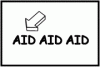     |
| Let's Takeoff! After activating their prior knowledge about the topic, the teacher presents the lesson on context clues and its types. The students are given the choice to study ONE of the following resource materials. They must also take note of salient points using the Cornell Notes format. A sample of the format is found in the learning module attached.
|
| Let's land! The teacher gives the students practice exercises to apply what they have learned on the topic of context clues by answering ONE of the following:
|
| Let's fly further! The students will be grouped into 5 different groups. Each group is assigned a text to use. Please note that the text should be preassigned so that there will be balance in the groupings. They are given the task to infer the meaning of unfamiliar words and identify the type of context clues used. The sample worksheet is found in the learning module attached. Once the students are done, one representative from each group should share their work to the class. Should there be questions from the class, the representative must be able to come up with an answer. 1. song lyrics 2. newspaper article 3. magazine article 4. blog post 5. scholarly journal |
| Afterwards, the teacher will elicit feedback from the class. The student/s from other groups should comment on the work of their classmates in terms of content and delivery. |
| The students are asked to reread their favorite story. They will have to apply their understanding of the lesson on context clues by identifying the meaning of unfamiliar words found in their chosen text. They must also indicate what type of context clue was used in the text. The worksheet they are going to use is the same as the one used in the grouping activity that is found in the learning module attached. |
| The students will share what they have learned from the lesson by posting on the class Insights Wall (offline) or Padlet Wall (online). They may choose to do ONE of the following options: 1. 3 - 2 - 1 (three things you have learned, two questions you still have in mind, one aspect of the lesson you enjoyed) 2. Acrostics (show what you have learned by composing a poem in which certain letters in each line form a word) 3. Three W's (What did we learn today? Why is the lesson important? How can you apply what you have learned in real life?) *If the Padlet Wall is chosen, the teacher should make one in padlet.com and share the link to the class. On the other hand, the teacher may make use of sticky notes and an empty wall if he or she prefers to do the task offline. |
| Worksheet/Handout Previews | ||


|
Attachments
-
Context Clues Reading Material.docx82 KB · Views: 351
-
Context Clues Reading Material.pdf475.6 KB · Views: 286
-
Context Clues Multiple Choice Exercise.docx93.1 KB · Views: 368
-
Context Clues Multiple Choice Exercise.pdf594.9 KB · Views: 477
-
Cornell Notes.docx88.9 KB · Views: 178
-
Cornell Notes.pdf332.1 KB · Views: 169
-
 1.gif2.2 KB · Views: 211
 -
 1.gif2.2 KB · Views: 140
 -
 2.gif30.4 KB · Views: 138
 -
 3.png3.7 KB · Views: 138
 -
 4.png1.9 KB · Views: 146
 -
 5.gif2.2 KB · Views: 139
 -
 1.png46.5 KB · Views: 132
 -
 2.png13 KB · Views: 142
 -
 3.png36.1 KB · Views: 141
Last edited by a moderator: